3 Years of OpenNext
Origin of OpenNext
OpenNext began as a serverless adapter created by SST (opens in a new tab) specifically for AWS Lambda, addressing the challenge of deploying Next.js applications on serverless platforms outside of Vercel's ecosystem.
OpenNext V3 and Community Expansion
The launch of OpenNext V3 in May 2024 (opens in a new tab) marked a pivotal shift, transforming the project from an AWS-focused tool into a more universal solution for Next.js portability. This version opened the door for other platforms to build their own adapters on top of OpenNext, with Cloudflare notably leveraging OpenNext's AWS adapter as a foundation for their own implementation. The expansion of OpenNext into a multi-platform initiative backed by contributions from Cloudflare, Netlify, and the broader community demonstrated the power of open-source collaboration in overcoming technical silos and making Next.js as platform-agnostic as possible.
Collaboration with Vercel
What started as an independent open-source project was later joined by Netlify and Cloudflare. Soon after, we started communicating with Vercel via unofficial channels. This collaboration grew even further with the creation of the Deployment Adapters Working Group, with others such as Google and AWS Amplify joining in. This group, in collaboration with Vercel, helped design what is today the Deployment Adapters API (opens in a new tab).
The Adapters API: Building the Future
It all started with an RFC, shared privately in December 2024, and then publicly in April 2025 (opens in a new tab). The RFC was met with a lot of positive feedback, and the Working Group was formed.
The Adapters API helps alleviate one of the biggest challenges OpenNext had to solve: the build output. The Adapters API allows us to avoid reverse-engineering features, as the build output now follows a clear contract that every platform can follow.
In Next.js 16 in October 2025, the Adapter API was released as an alpha. This was a major milestone, as it allowed us to start developing our new adapters in earnest.
And now, in March 2026, the Adapter API is stable in Next.js 16.2. Read more about this incredible milestone in the official Next.js announcement (opens in a new tab).
AWS and Cloudflare adapters are currently being built in a shared monorepo. The Netlify adapter is also in active development. We expect all three to be released by the end of 2026.
Don't worry, the current OpenNext adapters are not going anywhere. They will still be supported and maintained by the OpenNext community. In the case of Netlify, transition to the new adapter will be seamless for users.
What's Next?
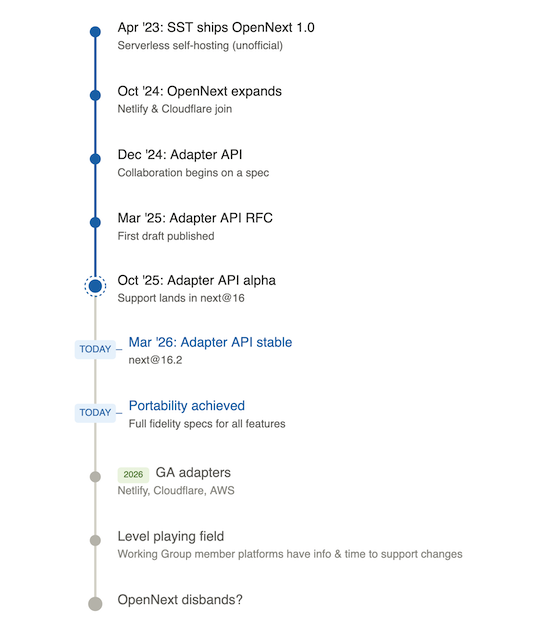
Over the last three years, OpenNext has played a crucial role in pushing Next.js toward true portability. Now, the introduction of the Adapters API signals a new era. And as announced today by the Next.js team (opens in a new tab), OpenNext along with Netlify and Cloudflare are founding members of the new Next.js Ecosystem Working Group (opens in a new tab), along with Google, AWS Amplify, and others. This initiative and Vercel's associated commitments give us great confidence that Next.js will remain a flexible, open framework for years to come. For developers, this means more choices, fewer limitations, and a stronger, more inclusive web development community.
The aims of OpenNext may evolve in the near future as we explore this new terrain together. Stay tuned.
The future of Next.js is not just open, it's everywhere.
Read more
Next.js, OpenNext, Netlify, and Google Firebase have published simultaneous companion posts:
- Read about the stable Adapter API, verified adapters, and the new working group in the Next.js blog post (opens in a new tab)
- Read about remaining architectural challenges in the Netlify blog post (opens in a new tab)
- Read about the Google Cloud perspective in the Firebase blog post (opens in a new tab)